
If we accept the premise that blogging is primarily storytelling, then if we can learn by writing stories, we can learn by blogging. Ana Ulin, who has a multicultural and multilingual background (and currently lives in Sweden) is the author of the blog at anaulin.org. In this entry, she offers … Continue reading
Monthly Archives: June 2005
Distributed Narrative
Ah, I think I’ve found a blogish kind of Web page that is somewhat analogous to the exploration of story/narrative I’m trying to conduct with this blog. In 2004, Jill Walker started researching distributed narratives. She uses this page to track her progress on the project. Her paper, Distributed Narrative: … Continue reading
Blog as a Disruptive Narrative Form
Supporting the notion that blogging is a form of storytelling:
Michael Heraghty and Gerald Adams prepared a 500-word proposal for the European Conference on Weblogs, 2003.
The authors contend that if no story moves through the “blog,” it is not a blog. Ulp — beginning to wonder if my blog is a blog on that basis. Perhaps mine is the story of my exploration of story.
Key points that especially resonate with me:
Sampling a Course in Storytelling
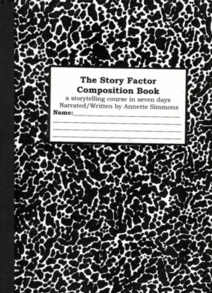
In an earlier entry, I described the presentation by storytelling author and expert Annette Simmons at a storytelling conference in Washington, DC, in April. I mentioned how Annette had pulled an Oprah-like act of generosity and given each audience member a copy of The Story Factor Composition Book (pictured) and the accompanying CD with a sample of the first two lessons that go with the composition book.
I finally had a chance to listen to the CD, and it was a delight to again listen to Annette’s Carolina twang. I’ve reviewed several audio products in my work for QuintCareers, and they are usually quite didactic and lecture-y. Annette’s is, conversely, completely conversational. The first two segments are about 20 minutes each, which seems like about the right length, and they are full of illustrative stories. I have to say that in all the research I’ve done about storytelling in the last year, proponents talk a lot about the value of story, but there seems to be a dearth of examples of actual stories. Not the case with Annette’s CD, which also offers some old-timey, twangy musical interludes that sound exactly like what you’d hear sitting around the campfire listening to stories. Continue reading
Blogs vs. E-zines
I recently received an article for publication from Suzanne Falter-Barns about how blogs are beating out ezines.
But I’m not so sure. I thought about ezine publishers I know who have switched to a blog format. Find Your Way was a newsletter that became a blog. It’s a good one, too, but I never think to check it out since I’m no longer receiving mailings about it from its publisher, Liz Sumner. In contrast, I get regular mailings from Kevin Donlin, who used to send an ezine but now sends monthly reminders of his blog. I rarely visit the blog, though, because the monthly reminders have sometimes linked to an annoying “audio postcard.” One of my favorite ezines is Jennifer Warwick’s Success Tips for Gutsy Women! Jennifer has just announced that she has started a blog, but she says the blog will fill a void between issues of her ezine. That seems to me to be a better approach than abandoning an ezine format altogether. At Quintessential Careers, we have an ezine, QuintZine, as well as what I would call a quasi-blog. If you don’t have both — or at least regular reminders to subscribers that they can visit your blog — readers may forget about you.
Many of Falter-Barns’s assertions make it seem as though blogs are better for the reader, but she actually makes them sound easier for the creator. She does make the point that if you trade your ezine in for a blog, you will no longer have to mess with subscription lists, which is a pretty good point. She says that all the e-marketers she knows have lost subscribers. QuintZine has not significantly lost subscribers since the Great AOL Meltdown (when AOL arbitrarily decided that we were spamming all our opt-in AOL subscribers, and we removed them from the list), but our list has remained static for more than a year. And we do all our circulation functions manually, so it would be kind of nice not to have to do that. Of course, at QuintCareers, it’s actually sort of a goal to lose subscribers because that means they have found a job and no longer need our advice.
Anyway, here’s Falter-Barns’s article:
I was all set this morning to write about something totally different in this issue … but thanks to the power of blogs, I’m here to deliver a totally different message. Namely the ascendance of blogs over ezines. Continue reading
A Narrative of Unemployment
I came across the blog of a guy named Greg who is an aspiring writer, and who, as of April 4, was unemployed. His 6-part (so far) narrative of his unemployment makes an interesting entry in the category of storytelling and career. He graduated from college in 2004 and does … Continue reading
A Nice Quote
“You are the storyteller of your own life, and you can create your own legend or not.” — Isabel Allende Courtesy of my partner, Randall. And Isabel Allende, of course.
Blogging about an iPod-delivered Audiobook on Blogging
I’m winding up a 13-day trip for my PhD program, during which I wanted to make blog entries every day, but I always had more pressing obligations. On my drive from VA to NH, I listened to an audiobook by Hugh Hewitt on blogging. I think that blogging about the … Continue reading
Telling Their Narratives Helps Women Gain Self-Understanding
I came across another fascinating piece that relates story to career, in this case the careers of women. Teresa J. Carter conducted a heuristic study in which she was co-researcher with 10 women. She interviewed them and also had them keep journals. Here’s the reference followed by the story-related excerpt:
Carter, T. J. (2002). The importance of talk to midcareer women’s development: A collaborative inquiry. The Journal of Business Communication, 39(1), p. 55+.
Telling their stories to me in narrative format through our conversations and through their journal entries became the means of re-framing identities and gaining self-understanding. Continue reading