In a blog posting called Using Stories To Sell: What Makes A Good Anecdote? (free registration required), Ford Harding lists 10 guidelines for stories used to make sales. It’s not too big a leap to see how these apply to the stories you can tell when you are selling yourself. My suggestions for using these in job-search situations follow each point:
1.
Make It Relevant: Choose stories that relate to the specific job you’re applying or interviewing for, and more specific to the interview, pick stories that help illustrate skills and experience the interviewer asks about.
2. Select An Anecdote With Which The Listener Can Relate: When stories convey moving content and are told with feeling, the listener feels an emotional bond with the storyteller. Often the listener can empathize or relate the story to an aspect of his or her own life. That bond instantly enables the listener to invest emotionally in your success.
job.3. Emphasize the Similarities: Be sure to draw clear parallels between your accomplishments in other jobs (or other aspects of your life) and what you would be doing in this job.
4. Every Good Story Has A Plot, Character, Action, and Outcome: In job-hunting, these stories are known by various acronyms, such as: P-A-R: Problem, Action, Result; S-A-R: Situation-Action-Result; and C-A-R: Challenge-Action-Result.
5. Use Only One Plot Per Anecdote: Keep it simple.
6. Use A Character With Whom Your Prospect Identifies: You, of course
7. Tailor Your Character To Your Listener: Pick up clues that enable you to tell your stories so that your actions sound like something the interviewer would do.
8. Describe Actions: Tell exactly what you did yo achieve results.
9. A Good Story Must Have A Clear Outcome: The outcome is your result, which will often sound even better if quantified.
10. Practice Your Stories: Along with other responses to interview questions, rehearse your stories.
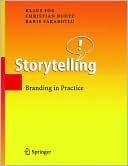
Storytelling: Branding in Practice. Publisher’s description:
As a concept, storytelling has won a decisive foothold in the debate on how brands of the future will be shaped. Yet, companies are still confused as to how and why storytelling can make a difference to their business. What is the point of telling stories anyway? What makes a good story? And how do you go about telling it so that it supports the company brand? This book is written for practitioners by practitioners. Through real life examples, simple guidelines and practical tools, the book aims to inspire companies to use storytelling as a means of building their brand – internally as well as externally.
A part of Hitachi’s Web site is True Stories, in video form, like the one below:
Trollbeads‘ current tagline is “Every story has a bead.”
citibank‘s current tagline is “What’s your story?” (“Whatever your story is, your Citi card can help you write it.”)
Theme parks, especially Disney, are often associated with storytelling. Quote in Orlando Sentinel, 4-14-06: “Story telling has always been the hallmark of attractions at Disney and Universal Orlando, where pre-shows immerse people in the theme of the ride.” Similarly, Sea World Orlando launched a new killer-whale show, Believe, in which trainers become storytellers, emerging from the water to tell their personal stories.
JetBlue, which previously sponsored a Story Booth project, invites customers to share their stories.
A company called The Fund runs a site called MyRealEstateStory.com in which real people tell real-estate horror stories to promote the idea of hiring a real-estate attorney.
Glamour magazine runs a section called Real Stories.
The makers of Gardasil, the cervical cancer vaccine, ran an ad with the headline: “Calling Gardasil a cervical cancer vaccine is only the beginning of the story.”
A site called MyFamousName.com invites people who share names with celebrities to share their stories.
Moissanite jewel is running a contest that invites entrants to share their stories of their most important Milestone Moment (such as first date with future husband, holding a first baby, a first big promotion) and win a pendant. The site also offers Milestone Moment example stories.
Headline for an ad promoting the Dr. Phil show: “The stories you care about as they happen.”
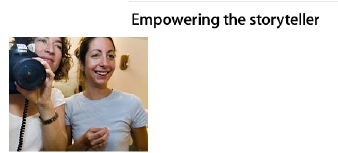
Apple credits its FinalCutPro software for “empowering the storyteller,” in this case photographer Lauren Greenfield who used Final Cut Pro to produce Thin, about young women in a treatment center for eating disorders.
Apple’s own story inspires Mitchell Harper of the software company Inspire, who writes about the importance of the corporate story in a blog posting.
In a 9-minute video, Shell Oil tells a warm, human story of how the snake oil drill, said to be relatively environmentally friendly, was invented by an engineer watching his son drink a milkshake through a bendy straw.
Thomas R. Clifford blogs about Harnessing the Power of Remarkable Corporate Video Stories to Ignite Conversations and Spark Action at Bringing Brands to Life.
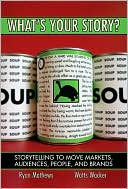
In What’s Your story? Storytelling to Move Markets, Audiences, People, and Brands, authors Ryan Mathews and Watts Wacker describe stories as the “most powerful, most underutilized tool for competitive advantage.” You can read more about the book in a two-part article by George Anderson about the book in the journal, Retail Wire (free subscription required): Part 1: Telling Stories for Profit and Part 2: Telling Stories for Profit.
After two years of trying, I still have not achieved the level of success I’d like in using storytelling in teaching – although I’ve gotten incrementally better at it.
… learning is very similar to storytelling. You need to give yourself vivid, memorable and emotionally descriptions of the information. When you learn with compelling metaphors, information seems to stick easily. Without metaphors, ideas are dry and slip through your ears without a second thought.
The Be the Change! Share the Story! school video contest invites student teams to choose and execute a social or environmental project of their choice and document their progress in a couple of short videos that will be uploaded on Quantum Shift TV between September 2007 and March 2008. An original, entertaining video puzzle game is woven into the contest to optimize the educational impact, allow for cross-pollination of ideas, encourage community involvement and increase visibility of the projects. Deadline is March 31, 2008.
As humans we continually story our experiences.
We construct our world through our personal, community, institutional and political narratives. The 2008 Narrative Matters conference theme aims to explore all of these narrative sites. Narrative continues to gain recognition as something people do, use and research. The Narrative Matters conference provides a meeting place for people interested in doing, using and researching narrative in diverse contexts and fields. The blurring and crossing of boundaries catalyzes discussion and inquiry at Narrative Matters conferences.
Conference Dates:
May 7-10, 2008
Venue and Location:
Courtyard Marriott Hotel
475 Yonge St. Toronto, Ontario, Canada
The Narrative Practitioner Conference will be held in the North East Wales Institute of Higher Education Wrexham North Wales in the UK June 23-25, 2008. The Narrative Practitioner site also has some nice links to narrative and storytelling resources.
Reinhard Kuchenmuller and his wife, Dr. Marianne Stifel, work for corporate clients doing visual facilitation. In an interview on Projects@Work (may require log-in), Kuchenmiller states:
Information presented in visual language as a picture-word combination is understood better and more quickly than information that is solely text-based. This is because information that is established in the non-verbal sphere of intelligence arouses associations and thus, remains better anchored for a longer period. We make use of visual learning preferences to achieve this goal. … It’s a simplification to say [that pictures work better than words alone in conveying information and making it stick in the mind], but we know that there are two sides of the brain, the creative and the logical. We’re all used to using the logic part at work, and saving the other part for our private lives, our hobbies, the cinema. I think the creative brain brings more deep insight to serious questions and it is connected to a universal treasure of pictures. After all, mankind started to draw pictures 40,000 years ago, and we only developed writing about 5,000 years ago. So, for 35,000 years, drawing was enough.
I recently did some research on learning styles for a book my partner and I are working on about study skills. I would venture to say the effectiveness of pictures over words or vice versa may depend largely on the type of learner you are – visual, auditory, etc. The debate reminds me a bit of the PowerPoint vs. story debate. Pecha Kucha, the Japanese-inspired minimailist slide-show style, leans toward the picture side, but requires spoken words to fully tell its story.
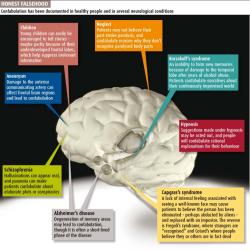
A fascinating article in New Scientist by Helen Phillips focused on “confabluation,” a tendency for folks in older age to “develop amnesia about recent happenings while retaining memory of their younger days.” Wrote Phillips:
“Until fairly recently it was seen simply as a neurological deficiency – a sign of something gone wrong. Now, however, it has become apparent that healthy people confabulate too. … we may all confabulate routinely as we try to rationalise decisions or justify opinions. Why do you love me? Why did you buy that outfit? Why did you choose that career? At the extreme, some experts argue that we can never be sure about what is actually real and so must confabulate all the time to try to make sense of the world around us.”
Ah yes, there is no objective reality. Reality is socially constructed through language, through story.
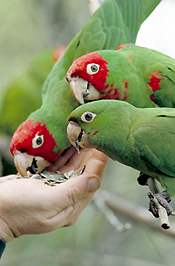
During a trip to San Francisco, my husband and I were walking down a terraced hill near Coit Tower when a woman came up to us and said, “Have you seen the wild parrots?” This question had the flavor of a bit of spy code as though she had said, “The crow flies at midnight,” and we were expected to confirm our identities with an appropriate response in spy-code.
We didn’t think much more of the incident until a couple of weeks ago when we happened to see a trailer for the documentary, The Wild Parrots of Telegraph Hill. We immediately knew that those were the parrots the woman had referred to, and of course, we had to rent the film.
What a treat it is! A wonderful, touching story – collection of stories, really – with a surprise twist at the end. You can get a bit of a flavor of it the Web site of Mark Bittner, the man who cared for the parrots for several years. See especially the Table of Contents of the book of the same name and Bittner’s photos. And see the film. It’s lovely.
As an avid cyclist, I was delighted to learn of the site crazyguyonabike.com that enables touring cyclists to journal about their bike tours. These folks are much more ambitious than my partner and I have been so far; we biked in about 12 states last summer but traveled between them in an RV. I’ve noticed that many touring cyclists are quite mature, so I hope to have some good tales to tell on crazyguyonabike.com at some point in my life.
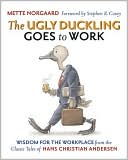
“Nothing changes until the story changes,” says Mette Norgaard, who puts on workshops and has written The Ugly Duckling Goes to Work, with workplace wisdom based on Hans Christian Andersen stories.
We provide innovative learning experiences in communities and organizations by creating surprise, energy, depth, and relationship around difficult issues like diversity and inclusive leadership. We do so using story, theatre and experiential processes, forming creative and safe spaces where people don’t have to be clever, but are free to truly learn and explore.
We help individuals in organizations deepen their working relationships across difference, transforming how they work together in the process and enhancing their capacity for innovation. Our work is more oriented toward learning (a process that leaves us changed) than toward problem-solving (a process focused on changing our surroundings) because we believe that changing our surroundings can only come after we ourselves are changed in some way.
John Kotre author of eight books about lives, memories, and legacies, all of which take a narrative approach, is collecting stories of personal cosmologies, as well as stories of journeys get from one understanding of the cosmos to another at his Web site.David Drake, PhD, offers the Center for Narrative Coaching. I saw his excellent presentation at last year’s Golden Fleece conference.
My friend and fellow Central Floridian Rick Stone is at i.d.e.a.s. with the title of Story Analytics Master.
MovingPictures helps companies tell their story. Check out the cool video, The Essence of a Story, on the company’s site.