Story Beginnings, Middles, and Ends Help Us Make Sense of Organizational Chaos

An ongoing emphasis here on A Storied Career has been defining story and examining how important it is to do so. For some, definitions aren’t important at all; for others, they are vitally important. (For a practitioner “conversation” about defining story, see this downloadable document: DefiningStory.pdf).

In a short new, visually stunning video, Terrence Gargiulo explores the beginnings, middles, and ends that, for many, define stories — but he takes that structure a step further to address the idea of making sense out of organizational discombobulation. Here’s how he captions the video:

Are things falling apart all around you? Have you been hit with discombobulation? This fast paced video turns our prevalent notions of sense making on its head. It’s always bothered me that when we talk about story we usually talk about stories requiring Beginnings, Middles, and Ends. I don’t disagree. I’ve finally been able to put my finger on what I felt compelled to articulate…

Watch and see what discombobulation, stories, and a new way of thinking about stories adds to your current way of thinking about them. Then be sure to add your voice to the conversation, after all stories beg us to co-create with each other.

What’s your response to Terrence’s “new way of thinking about stories?”

Q&A with a Story Guru: Lisa Bloom: Many Influences Inspired Her

See a photo of Lisa, her bio, Part 1 of this Q&A, Part 2, and Part 3, and Part 4.


Lisa is repeating the teleseminar, “Success Story Secrets,” that she presented earlier this week, offering a chance for coaches to learn all about how to attract clients, build business and increase confidence by finding their success story!

It will be TOMORROW, Saturday, May 1 at 4 pm Eastern.

Click here to reserve your spot now on this complimentary call.


Q&A with Lisa Bloom, Question 5:

Q: What people or entities (such as Web sites, blogs, books, organizations, conferences, etc.) have been most influential to you in your story work and why?

There have been lots of influences in my life and work in relation to story.

  • My parents told stories at home all the time and always encouraged me to tell my stories.
  • My father’s wonderful friend, a Catholic priest, who used to read me bible stories, and later guided me in my own personal soul searching in relation to faith and the meaning in life. He is one of my first storytellers!
  • Annette Simmons’ books: I love the way she writes and her books are jam packed with story wisdom. There are other authors and story practitioners that I am grateful to as well; Steve Denning, Sue Jennings, Jack Maguire, Clarissa Pinkola Estes, Allison Cox, to name but a few!
  • Doug Lipman‘s very wise and generous story guidance is a reference I go back to again and again to make sure my story delivery is right on the mark.
  • The Moth.Org is a site that I visit regularly to hear and be inspired by very natural and entertaining personal storytelling.
  • Byron Katie is a great inspiration to me in terms of examining your story in order to look at the reality you have created.
  • The International Coach Academy has been a great support to me in my Story Coaching journey. They love storytelling and have encouraged me along the way in creating my programs for coaches.
  • The International Coach Federation has supported me in accrediting my program “Cinderella and the Coach — the Power of Storytelling for Coaching Success!” and I will be participating in Virtual Education and Local Chapter programs in the next few months.
  • And I must not forget TED.com that is a constant source of inspiration and awe!

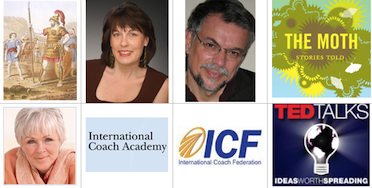
[Pictured below: Top row, from left: Bible stories, Annette Simmons, Doug Lipman, The Moth; Bottom row: Byron Katie, International Coach Academy, International Coach Federation, TED.]

Q&A with a Story Guru: Lisa Bloom: Storytelling is Rooted in Every Culture and Every Place

See a photo of Lisa, her bio, Part 1 of this Q&A, Part 2, and Part 3.


Lisa is repeating the teleseminar, “Success Story Secrets,” that she presented earlier this week, offering a chance for coaches to learn all about how to attract clients, build business and increase confidence by finding their success story!

It will be Saturday, May 1 at 4pm Eastern.

Click here to reserve your spot now on this complimentary call.


Q&A with Lisa Bloom, Question 4:

Q: You grew up in Israel, traveled to many other places globally, and returned to Israel. What cultural differences have to observed in the ways stories are told, used, and regarded around the world?

A: Actually, I grew up in Ireland and moved to Israel when I was 18. I spent the next 10 years in Israel, more or less, aside from about three years in the middle where I traveled extensively. Then, returned to Ireland for an additional seven years before setting up home here in Israel (again!).

I’m always fascinated how the same stories show up in many cultures. I told a traditional Irish story about two horses at a Storytelling Evening in Jerusalem. The host thanked me and then said that he tells the very same story about two donkeys in Jerusalem! This is not an unusual occurrence; it seems to be quite universal.

My experience is that the power of story and storytelling is universal. People love to hear stories and it connects them to a place of long ago, a time when society valued the storyteller more. I think that this sense of value of the power of stories and the important role of the storyteller has been somewhat lost in modern western world cultures. But, as we discussed earlier, there is a return to these values.

The Irish storytelling culture is very strong historically. However, it has been negatively affected by the economic boom in Ireland and the breakdown of the family and community. While there are less frequent gatherings of extended families or community, there is less opportunity to create the storytelling environment that was so rooted in Irish History. Nowadays, there is certainly a revival and I believe a strong emerging storytelling community. Similarly, the Jewish culture has traditionally cultivated stories and storytelling as a way to preserve history and values. This has somewhat broken down in modern society but where the traditions are practised, the stories thrive. Again, Israel is experiencing a revival of storytelling as an art form and there are more traditional storytellers here than ever!

In conclusion, my personal experience has not led me to see great differences in cultural attitudes to storytelling. Perhaps if I were comparing Africa or India to America, there would be more obvious cultural differences. I believe that storytelling is rooted in every culture and every place; and thankfully, it is being nurtured back to life as practitioners all over the world rediscover the almost lost culture and art of storytelling.

Q&A with a Story Guru: Lisa Bloom: Technology, Community, Trust Account for Surge in Storytelling

See a photo of Lisa, her bio, Part 1 of this Q&A, Part 2.


Q&A with Lisa Bloom, Question 3:

Q: The storytelling movement seems to be growing explosively. Why now? What is it about this moment in human history and culture that makes storytelling so resonant with so many people right now?

A: I believe that there are several reasons for the explosive growth of storytelling. Here are the ones that I feel are most relevant:

Community: There has been a breakdown of traditional communities in most cultures. As a result, not only are people isolated socially, they are also lacking the access to the traditional lessons that were taught through community interaction. They have less opportunity to understand value systems that traditionally were taught through communities. Storytelling brings back that sense of community, values and a context in which they can be practiced. The stories communicate how people used to live and the lessons that were taught in the community setting. t is an access to the way the world used to be and the way people lived in that world; and it is welcomed by so many isolated individuals that crave the warmth, safety and clarity of values that a community can offer.

Technology: Nowadays, we are inundated with technology; and this allows us vast amounts of information that need to be deciphered and choices that need to be made. This unlimited supply of information becomes very confusing and quite overwhelming. As a result people have begun to crave the simplicity of the story. The simple story brings us back to a place of comfort (sometimes as a reminder of childhood) where things were clear. The choices are limited, the world within the story is familiar and predictable and the overall experience is safe and comforting.

What is interesting is that technology has also become a storytelling tool; so it is both the source of confusion and isolation while delivering the remedy to this problem through digital and technology enhanced story experiences.

The “Trust” Issue: Over the last few years, there has been major breaches of public trust, particularly in the area of personal finances, general economic solidity and the church. When your life long savings suddenly become worthless because someone else has been greedy and untruthful; when the nation’s financial institutions are threatening to collapse; when the church’s leading figures are accused of causing unspeakable harm to helpless community members (particularly children), you’ve got to wonder who you can trust. In this light of this major trust issue, the person who tells a story that you can believe in goes a long way to repairing faith and trust. I believe that as a result of these major breaches in trust, people crave stories that they can hear and instinctively believe in. When we don’t know who to trust, it is a relief to “believe” someone’s story; this is one of the main reasons that storytelling resonates so much for people at this present time in history.

Q&A with a Story Guru: Lisa Bloom: Narrative is an Integral Part of How We Define Our Lives

story_practitioners_small.jpg

See a photo of Lisa, her bio, and Part 1 of this Q&A.


Lisa is presenting a teleseminar, “Success Story Secrets,” TODAY, April 27 at 2 pm Eastern, offering a chance for coaches to learn all about how to attract clients, build business and increase confidence by finding their success story!

Click here to reserve your spot now on this complimentary call.


Q&A with Lisa Bloom, Question 2:

Q: How did you initially become involved with story/storytelling/narrative? What attracted you to this field? What do you love about it?

A: I have been telling stories my whole life, it’s a part of who I am! I think that with my Irish and Jewish upbringing, it was kind of inevitable! I discovered storytelling professionally when I was a training and development manager and found that the more stories I told, the more my training courses were successful. People responded to stories in an entirely different way than when I simply “taught” the material of the courses. So, I started to use stories more and more and found that the participants were so much more engaged and retained the material much better. I moved to coaching after I had young kids and wanted a home-based, self-run business. As I attained my professional coaching qualification, I wrote a research paper on the connection between storytelling and coaching and then I realised how incredibly interwoven the two fields are. So, as I developed my coaching practice, I started to see areas where other coaches could benefit from my use of storytelling.

I love telling stories. And I love to hear a good story told (or a story told well!). I believe that everyone has a story and that’s part of what fascinates me about story coaching. To be able to hear people’s stories, and help them tell their stories in an authentic and heartfelt way is an honor. It’s also incredibly empowering for my clients to understand how narrative is an integral part of how we define our lives, and for them to begin to create new stories. It’s true what they say, that when you find what you love and can make a living from it, you never have to work another day in your life! That’s how I feel about story coaching.

Q&A with a Story Guru: Lisa Bloom: Story Coaching Helps Us Discover, Tell Stories That Create New Reality

I’ve been aware of Lisa for quite a while and mentioned her in a roundup of coaches who use story. She made wonderful contributions to the teleseminar I led last fall on why storytelling is getting so much attention now. I’m thrilled to present her Q&A, which will run for the next five days.

Bio: Lisa Bloom is a highly professional and accomplished Storyteller, Training and Development Specialist and Professional Certified Coach (ICF) with more than 20 years experience working in public and private sectors, high-tech and financial services environments. Lisa has excellent capability in needs analysis, program development and delivery, and project management. She has proven ability in increasing organizational effectiveness through consulting, coaching, and learning and development skills. And she can spin a great yarn!

The real magic, however, has been in combining Lisa’s greatest passions, experience and skills to create Story Coach.


Lisa is presenting a teleseminar, “Success Story Secrets,” Tuesday, April 27 at 2 pm Eastern, offering a chance for coaches to learn all about how to attract clients, build business and increase confidence by finding their success story!

Click here to reserve your spot now on this complimentary call.


Q&A with Lisa Bloom, Question 1:

Q: One thing that distinguishes you from other coaches who use storytelling in their practices is that you offer training to coaches in your techniques. Can you talk a bit about some highlights of training other coaches, as well as how you came up with the “Cinderella and the Coach” metaphor?

A: I love showing coaches how to use storytelling because it’s so instinctive for so many people, it’s like pointing out the obvious, the metaphor that lives in each client and each coach. What I mean is that I believe that we are all storytellers, in that we all tell our life stories all the time. We ‘tell’ how we got to work this morning, where we ate dinner last night and how we feel about Aunt Bertha coming to visit next week! We constantly tell our lives to the people around us. And the telling is completely subjective; we chose the words, we chose the narrative in every way. It’s like two siblings growing up in the same house, they tell a completely different story of their childhoods. What this means is that if we examine our stories, really look closely at what we choose to tell, we can determine whether our stories serve us well or whether they actually create the problems in our lives. So, our stories define our reality. As we examine this reality, we can make changes that help create amazing transformations in life.

Now clearly there are issues and incidents in life that we cannot change. But so often our suffering comes from the way we interpret and live with these unchangeable incidents. Coaching helps us find the tools and resources to change what we can and live better with what we cannot change. Story coaching helps us discover and tell the stories that create the new reality.

What I love about training other coaches is that, as a group, they are a very self-enlightened bunch! Coaches are personal development junkies! So working with them is a treat; their outlook is positive, they believe in the power of change and transformation, they are curious about other people and passionate about helping others achieve more fulfilling lives. Usually coaches love stories! Listening to stories is so much a part of our work, so when I give other coaches the tools and skill-set to really understand storytelling and how powerful it is in the coaching context, it helps their business and life thrive. There is no greater honor or joy for me!

The name, “Cinderella and the Coach — the Power of Storytelling for Coaching Success!” is a play on words (of course) but also immediately focuses on the power of the stories we live with. Everyone knows the Cinderella story, so there is an immediately connection. t is a story of transformation, and story coaching is intensely transformative so it fits the title!

Stories of Replacement Children

I was instantly attracted to Judy Mandel’s memoir, Replacement Child. Mandel’s sister, Donna, whom she never knew, was killed when a plane crashed into her family’s home. Mandel was envisioned as Donna’s replacement. Here’s more description:

A plane crash — the impossible choice a mother must make — the death of
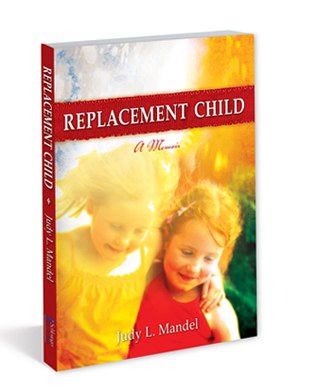
a child — leave a hole in the family that threatens to tear it apart. In a great act of hope, the parents give birth to a “replacement child,” born to heal wounds and provide a “salve for the burns.” The child unwittingly plays her role throughout childhood, riding the deep and hidden currents of the family tragedy. Years later, as an adult, she discovers the truth of her family’s life-changing event and the complex layers of her own relationships with her father, mother, and sister.

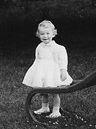
The description of the book speaks to me because I, too, was a replacement child. My sister Betsy (pictured), born 59 years ago today, was killed about a month before her second birthday when a car driven by my parents’ landlady backed over her, crushing her skull.

I was born 364 days after her death.
Of course, my situation was somewhat different from Mandel’s. Her sister was 7 when she was killed, and thus had a much more fully formed personality than Betsy did at age 23 months. Mandel had a much bigger job as replacement child for her sister. All I really had to do was be born a girl. During three out of my mother’s four pregnancies, my parents hoped for a boy. But they hoped I would be a girl to replace Betsy.

As soon as I learned of my departed sister’s existence, I was far less consumed with replacing her than with longing for her presence in my life as my big sister. I grew up feeling I was meant to have, not be, a big sister. My role — or perhaps the role I tried to fit into — was reflected in the imaginative games my sisters and I played as children (my parents never did get their wished-for boy); my younger sister Robin would always play the mother when we played “house,” while I played the big sister. I used to pray for Betsy to return to life — for just one day — so I could have a big sister. Later as a teenager, I ached for a big sister who could show me the ropes of things like applying to colleges.

The Encyclopedia of Death and Dying cites Replacement Children as a fairly common phenomenon:

When a child is born into a family that has suffered such a loss, there is concern that the new child might be compromised in his or her development. Such a baby is often described as a “replacement child,” a substitute or replacement for the child who died. This baby is thought to be at risk for later psychological difficulties because of an inability to form an identity separate from the dead child.

I’m guessing (not having read her memoir) that this difficulty in forming a separate identity may have been an issue for Mandel, but it was much less so for me because Betsy’s identity was still so unformed.

Research has been conducted on replacement children, such as the work done by Leslie A. Grout and Bronna D. Romanoff that took the form of a

qualitative interview study [that] examines the family stories told by bereaved parents, with particular attention to how parents represent the dead child and subsequent children in the current family structure. We categorized parents’ stories as those which suggested that parents replaced the loss by an emphasis on parenting subsequent children, or maintained a connection to the dead child through storytelling and ritual behavior. The two ways in which parents maintained the connection were to preserve the space in the family that the dead child would have inhabited, or to create an on-going relationship with the dead child for themselves and their subsequent children.

I would suggest that my parents did both. They preserved Betsy’s space with me, but they also created an on-going relationship with the dead child for themselves and their subsequent children; in our nightly prayers before bed, we would always say, “And God bless Betsy up in heaven.”


What “replacement child” stories do you know? Are you a replacement child?

Two Very Different Approaches to Personal Stories

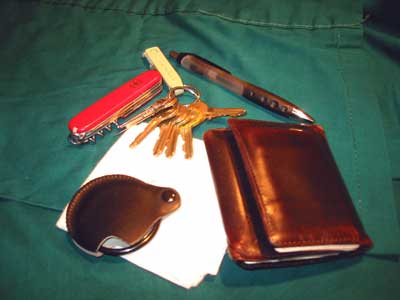
What kind of story could you tell about yourself based on the contents of your pocket, backpack, handbag, or wallet?

That’s the question that the Pocketology Field Research Unit explores on Stories You Haven’t Heard. (Carol McLeod made me aware of pocketology). Here’s how the site describes pocketology:

Pocketology, the study of pockets, is an exploration of how objects we interact with on a daily basis help form the story of our lives. The objects we accumulate in our daily experience become the puzzle pieces of our days; the evidence of how we live life as individuals in the context of larger communities. … Stories You Haven’t Heard [the official blog of the Portrait Gallery of Pocketology] is a place to tell and read about the parts of life that happen while we are busy making other plans. Excavating items we find in our pockets or backpacks (handbags, wallets, etc) we evaluate the origins of these often overlooked artifacts and honour stories that contribute to the larger picture of our daily lives. … All those who feel inspired are invited to dig into coat pockets and old wallets. Discover these artifacts and share your stories with the Pocketology community.

[Photo credit: J. F. Strain]

The site then invites visitors to email pocket stories, ideally with photos of the artifacts found in the storyteller’s pocket (or similar container).

I’m glad the site mentions backpacks, handbags, and wallets; otherwise, pocketology would be biased toward men. One of my pet peeves has always been that women’s clothing doesn’t have enough pockets. You can see some sample pocket stories on the site.

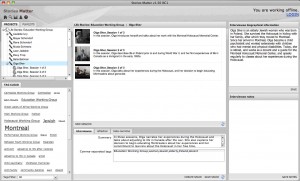
My second discovery is perhaps less of an approach than a tool for transcribing oral history. It’s a free software application called Stories Matter (v.1.5.1), described as a “database tool: a new media alternative to oral history transcription” that addresses this issue: “In transcribing our interviews, we lose the orality almost immediately thus shoring the narratives of much of their meaning.”

The folks at the Centre for Oral History and Digital Storytelling, developed the tool that allows oral historians “to clip, index and export audio and video recordings — and so it represents a real alternative to transcription.” The developers at Centre for Oral History and Digital Storytelling have been using Stories Matter extensively for the past six months and are in the process of building a large database for their Life Stories project, “which is interviewing survivors of war, genocide and other human rights abuses.”

I wish I could have downloaded Stories Matter and used it or at least taken a better look at it. The application uses Adobe AIR, and my computer got caught in an endless loop of trying to install AIR, to the point where I couldn’t open any of my applications (a memory issue perhaps?). I’d be interested in hearing if and how any readers are using it. You can get some sense of what the app is like by clicking on the small screenshot image below, which will take you a larger version of the image:

Q&A with A Story Guru: Kim Pearson: Writers, It’s Not About You

See a photo of Kim, her bio, Part 1 of this Q&A, Part 2, Part 3, and Part 4.


Q&A with Kim Pearson, Question 5:

Q: If you could share just one piece of advice or wisdom about story/storytelling/narrative with readers, what would it be?

A: I put a sticky note on my computer which says “It’s not about you.” Even if you are telling your own life story, it’s still not about you. It’s about your readers or your listeners. Stories come through you, not from you.

If you write books, articles or a blog, you’ve probably been told that writing new and useful content is of vital importance. Content is King, in other words.

I disagree. Content is vitally important, but it isn’t King. We don’t live in a monarchy, and your readers are not your loyal subjects. You don’t get to stuff your content down your readers’ throats — or through their eyes. (Sounds painful, doesn’t it?)

Content is more like the president. It’s only good if it’s elected by a majority of the populace — the readers. That’s because the president serves the people. He or she cares about what they think, because if he/she doesn’t, he/she won’t be president very long.

Many writers say, with great pride, that they “write for themselves,” as if this means they are a “real” writer, in touch with their Muse. But this is only true if you are writing a journal, meant just for your eyes.

Books, articles, blog posts and the like are communication vehicles. All effective communication is two-way. The written word is no exception. You have to know what is important to your reader. Otherwise, he or she will not read your writing. People have a choice to read your book or blog, or not to read it. It’s as simple as that.

How you present your ideas must be done in a way that your readers will understand or be entertained by. Yes, I am talking about slanting your writing.

Slanting your writing so that your reader can “get” you is not pandering, manipulation, or selling out. It is simply good communication. It shows respect for your reader. You are paying attention to what they care about. Aren’t you more likely to listen when people pay attention to your interests, and offer you respect by talking in terms you understand? Of course you are. It’s the same with writing.

Tailoring your writing to your reader’s “care abouts” will allow you to elicit emotional responses from them. You want bells to go off in their heads, or for them to snap their fingers with delight, or be dazzled by the brilliant light you have poured over them. Emotional responses lead to action or change. And that’s ultimately what you’re trying to get from your reader — you want them to do something, or learn something.

You can only emotionally hook them if you know what they care about.

This does not mean you are pandering or betraying your own muse. All it means is that you are treating your readers with respect, and paying attention to who they are.

After all, the reason you write is so someone else will read it. It’s not about you.

Q&A with A Story Guru: Kim Pearson: Sharing Your Stories is an Affirmation of Belonging

See a photo of Kim, her bio, Part 1 of this Q&A, Part 2, and Part 3.


Q&A with Kim Pearson, Question 4:

Q: The bio on your Web site suggests that your ability to conduct interviews with skill is key to your success as a writer/ghostwriter/storyteller. Without giving away all your trade secrets, can you offer readers a bit of insight into your interviewing techniques? To what extent does your training as a historian help you as an interviewer?

A: Most people see history as something outside them. They don’t see themselves as part of history. But they are. When I interview my memoir clients, I come from a historian’s perspective — I look for how they intersected with the events and trends of their time. Asking about these events and trends opens a rich vein of stories. This is what I tell them:

You make history. History is not just about the famous or the infamous. It is not just about “big” things that make the newspapers. History is merely connection over time. We are all connected to each other, to the past, and to the future. We are connected by our stories.

We are all actors in the powerful drama of earth, part of the vast dynamic web circling the universe. Our actions reverberate along this web, creating consequences for all other living creatures. We do not merely react to events and historical trends — we create them. Each individual, even you, is a part of history.

You are a witness to history, as well as an actor. Do not underestimate the necessity of this role. You know what you saw and what you experienced. Tyrants and unscrupulous power-seekers always seek to rewrite the inconvenient (to them) past. This is why it is often said that history is “written by the winners.” But those who preserve their stories help ensure that the truth remains.

How many of us wish they had an ancestor’s story, told in their own words? Wouldn’t it be wonderful, we think, to know the hopes, dreams, wishes and fears of Great-Great-Grandma as she bounced over the plains in a covered wagon? Wouldn’t it be cool to know what Great-Great Uncle Joe was thinking while he robbed that bank?

Yes, it would be wonderful to know our ancestors’ stories. But what we often forget is that we, too, are someone’s ancestor. We are the future historians’ primary sources. A primary source is a term historians use to describe the thoughts, opinions and witness of those people who were really there. When you record what you saw, what you felt, what you did, you become a primary source. Two hundred years from now, historians could be looking for you. What do you want them to find? Just your tombstone with the dates of your birth and death, and perhaps a line of verse? Does that tell your dreams, desires, triumphs, griefs, loves and hates? Does it tell what part you played in the story of the world?

Sharing your stories is an affirmation of belonging. You have a rightful place here. Without you, the history of the world is incomplete.