Dispatches and Goodies from the Story World

For story fans, here are some recent initiatives and goodies worth your attention:

    • The 10,000 Strangers Campaign. From July 30-Nov. 6, 2012 (election day), Matthew Ross Smith will slowly drive across America. His goal is to shake 10,000 hands in 100 days. He will do this by introducing himself to 10,000 strangers in parks, libraries, and other public spaces. For anyone who will take 30 seconds to talk to him (no guarantee these days), he’ll offer a self-addressed, pre-stamped postcard with instructions to share a single memory — “a story you don’t want to be forgotten” (along with a photograph or illustration) and mail it back. This project is a spinoff of Smith’s Spaces Between Your Fingers Project. Read more about 10,000 Strangers here and here.

    • The Talking Shop, a six-part radio series on stories and storytelling, was recorded in April and May by the Academy of Oratory; the recordings can now be heard online. The series consists of:
      • Episode 1: Stories and Storytelling
      • Episode 2: Stories and Learning
      • Episode 3: Stories and Healing
      • Episode 4: Stories and Leaving
      • Episode 5: Stories and Leading
      • Episode 6: Stories and Formation

Find all the files here.

    • Storytelling: The Deeper Level, is a 19-minute video that Limor Shiponi created based on a request by Madelyn Blair for a business storytelling course. See it here.

  • The Museum of Broken Relationships grew from a traveling exhibition revolving around the concept of failed relationships and their ruins. The Museum describes itself as offering “a chance to overcome an emotional collapse through creation: by contributing to the Museum’s collection.” Conceptualized in Croatia by Olinka Vištica and Dražen Grubišić, the Museum has since toured internationally, amassing its collection. The museum’s site notes that “people embraced the idea of exhibiting their love legacy as a sort of a ritual, a solemn ceremony.” Check it out here.
  • Learning Through Stories is a new project by Annie Murphy Paul on the Brilliant Blog: Learning Through Stories. Writes Paul: “A lot of scientific research — and our own experience — demonstrates that we understand and remember material best when it’s presented to us as a narrative, or when we tell our own story about it. So: Once a week, I’ll be inviting you to share your stories of where and when and how you learned something in particular. And I’ll be asking you to do one additional, perhaps challenging thing that is nevertheless the key to the exercise: to draw out a generalizable lesson from your story that could apply to the learning of other things, and could be used by people other than yourself.” The project’s first question is: “How did you learn to ride a bike?”
  • YoMu is a very high-tech, high-concept tool described as “a mobile and personal museum experience.” You really have to see a demo (embedded below) to gain even a glimpse of understanding of what it does, though its site notes: “It will be your guide, tell you hidden stories and show you images, art and sounds that surround you. YoMu is a personalized, situational awareness app that let’s you (re)discover the city you live in. I’m not completely convinced that YoMu is a story tool, but I’m a sucker for technology I’ve never seen before. Check it out here.

Q and A with a Story Guru: MaryLou Wakefield: Story Helps Us Relate to the Struggles of Others and Celebrate Their Journey

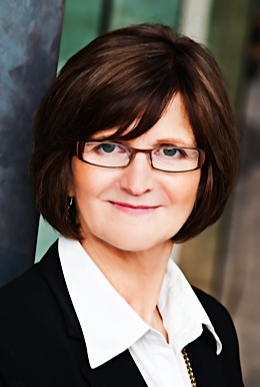
See a photo of MaryLou, her bio, Part 1 of this Q&A, Part 2, Part 3, and Part 4.

Q&A with MaryLou Wakefield, Question 5:

Q: The storytelling movement seems to be growing explosively. Why now? What is it about this moment in human history and culture that makes storytelling so resonant with so many people right now?

A: A great question and a great metaphor. I’m not a scholar who’s studied the literature, or written in academic journals about this subject; I’m just a keen observer and active participant in the changing cultural landscape. A lot seems to be exploding at this time in history. We’re in a period of huge upheaval and massive change. People are literally rebelling in the streets against what isn’t working for them — corrupt political regimes, unscrupulous media moguls, and the world economy, come to mind. Broken political, economic and entrepreneurial systems are being discarded all over the world. On the other side of the equation — art, music, writing, and publishing are also exploding and in ways we haven’t seen before. Independent producers of all forms of art are using new tools and new channels of distribution to get their work out into the world. They’re sourcing funding from fans, producing their own art, recording their own music and sharing it with the world on their own. Incredible.

But there’s a paradox. We’re seeing an unprecedented explosion of information on the Internet and through social-media platforms, but more information doesn’t equal more intelligence, more meaning, or more connection. And that’s what people seem to be hungry for. Meaning through context, and connection through emotion. So, perhaps story and storytelling is enjoying popularity at this particular time in history because of its ability to connect us to each other. And in a world gone mad with explosions of all sorts, perhaps what we’re all searching for is to simply feel a visceral connection to another person, to relate to their struggle and celebrate their journey.

Learn to Define and Apply Your Story Type in Friday (June 29) Podcast

Q&A participant Cindy Atlee will be the guest during a podcast tomorrow (Friday, June 29) at 12 Noon Pacific Time on VoiceAmerica Business Channel.

The show is called “The Leader Within: Define Your Professional ‘Story Type’ and Success Motivators,” and here’s the blurb about it:

Do you know who you are at your absolute best—and how to let others know, see and value that part of you? Can you engage and inspire others with a distinctive leadership voice and message? Join host, Rasheryl McCreary (pictured) and her guest, Cindy Atlee, principal of The Storybranding Group as they explore how senior executives, emerging leaders and other working professionals can make sense of who they are, what they stand for and how to bring the best parts of themselves to work every day. In this episode, you will learn how to use, define and apply the “story type” that represents who you really are at your best. We’ll also explore strategies that enable you to translate your most powerful strengths and values into a motivating professional mission and vision for your worklife, and use that to fuel what’s most purposeful, passionate, vibrant and vital about you. Tune in to The Leader and The Muse to catch expert advice and practical tips that can help you build your brand.

Click here for more information and to listen to the show.

Q and A with a Story Guru: MaryLou Wakefield: Circumnavigation Saga Illustrates Immense Power of Story

See a photo of MaryLou, her bio, Part 1 of this Q&A, Part 2, and Part 3.

Q&A with MaryLou Wakefield, Question 4:

Q: In the very first entry in your blog last year, you wrote about the blog describing your husband’s effort to complete a solo non-stop westward circumnavigation: “I was part of an amazing story-telling blog a few years ago that did change lives. Mine for one.” Can you talk a bit about how the experience and the blog changed your life?

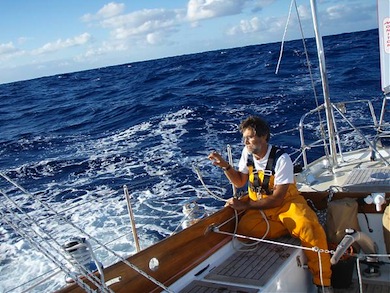
I’d love to. It’s a big story (we’re working on a book), but I’ll try to keep it short. It was one of the most profound experiences I’ve ever been involved with for a lot of reasons. In 2007, my husband Glenn set out on a very personal journey to fulfill what was his lifelong dream. He attempted a single-handed non-stop circumnavigation from Victoria, B.C., Canada. I created a website and blog named after our boat, Kim Chow, called www.kimchowaroundtheworld.com. It was a way to keep family and friends up to date without having to send dozens of emails.

Glenn was adamant from the outset that he didn’t want a media frenzy so we kept the details of his departure quiet until a few days before he left. On departure day, the media showed up and the story made the local TV, radio and print news. The story went national, and the day before he left (Sept 23, 2007), an astonishing thing happened. I got dozens of emails from complete strangers across Canada who wanted him to know they supported him. Glenn was astounded that so many people took the time to reach out to him with personal, heartfelt messages.

Every day, I posted to the blog about his progress. This was straight-up stuff about what he was feeling out there on his own, the hardships, the weather challenges, the exhilaration, the loneliness, the daily challenge to keep the boat going, etc. It was honest and heartfelt. Within weeks we had hundreds and then thousands of people following, asking questions about him, the boat, the preparations, what he was eating, his motivation, his family, me, etc. I found myself, unexpectedly, at was the hub of this global communications wheel in addition to my full-time day job and family responsibilities. It was often overwhelming and at the same time inspiring. I got email from kids in Saskatchewan who were following his journey as part of their geography curriculum. There were requests from the media around the world wanting interviews and stories, which I was happy to provide. I posted questions, and when he wrote back, posted his answers. More blog posts, more questions, more answers and a lot more drama. In the end we had about 50,000 hits to the site from people in 109 countries. Most of them checked in every day to follow him, and many took time to write an email to me to tell me how his journey had made an impact on their life and their family’s life. That drama unfolded for seven and a half months (220 days) until his boat capsized off Cape Horn after five days of severe, relentless storms. He was injured, rescued by the Argentinian navy, and, in the end we lost our boat. So, how did all that change my life.

I was tested in more ways than I could have ever imagined, and on so many levels, not just as a storyteller. It was an emotional roller coaster from start to finish. And here’s the thing that has stayed with me. I was fully engaged every step of the way and felt privileged to be on the receiving end of the most honest, heartfelt messages from hundreds of strangers around the world who told me Glenn was an inspiration to them and that I was the bravest person they knew. Messages from kids who called Glenn their hero, and folks who wished they could somehow help Glenn after he abandoned his dream, and who have since told him how much his courage inspired them to do things they thought they couldn’t possibly do. Because of all that, I now know more than ever before and in the most personal way, that story has immense power and that the human spirit is truly amazing; never to be underestimated.

(Footnote: Glenn is planning a second attempt at a solo non-stop circumnavigation from Victoria, BC, Canada, in the summer/fall of 2012 and I’ll be here telling the story online).

Q and A with a Story Guru: MaryLou Wakefield: 3 Essential Characteristics of a Story That Matters

See a photo of MaryLou, her bio, Part 1 of this Q&A, and Part 2.

Q&A with MaryLou Wakefield, Question 3:

Q: Can you explain why you capitalize STO in your blog name, STOrythatMatters?

A: Initially when I was playing around with names for my consulting business, I landed on Story that Matters because I really liked what the words meant. I knew I wanted to show up in a more interesting way (within the limits imposed by the digital space), so I worked out a few variations and decided on STOrythatMatters. I sat down with a few friends and colleagues who knew me and understood my passion, to brainstorm what STO could stand for.

Collectively, we arrived at S is for Significant, T is for True, and O is for Original. It was a great way to collaborate, and in the end I got three words that express what I feel are the essential characteristics of a story that matters.

Q and A with a Story Guru: MaryLou Wakefield: An Exciting Time to Be in the Storytelling Business

See a photo of MaryLou, her bio, and Part 1 of this Q&A.

Q&A with MaryLou Wakefield, Question 2:

Q: I get the impression that Wakefield Communications’ focus on story and storytelling is somewhat recent. What inspired you to shift to a storytelling focus for your communications firm?

A: I’ve been telling stories in my work for two decades. I just didn’t call it that. It’s where my passion is. It’s where I come from, and it’s where I feel the most energy and commitment. I’ve experienced the impact of stories firsthand, personally and in business and I’m excited about sharing what I’ve learned in the process. I know the business (and non-profit) communities stand to benefit immensely from discovering and sharing their stories to connect and build meaningful relationships. It’s an exciting time to be in the storytelling business.

Q and A with a Story Guru: MaryLou Wakefield: Stories Have the Power to Connect People in Profound Ways

I discovered MaryLou Wakefield through my Scoop.it curation of organizational storytelling and was later delighted to find her in attendance at the recent Reinvention Summit 2, where she contributed enormously to the conversation with insightful comments and questions. The Q&A, 98th in a series, will run over the next several days.

Bio: [in her own words] My professional experience is in communications, marketing and public relations. I’ve worked in health care, the arts, tourism, post-secondary education, ad agencies and for many small businesses. I created and develop content for a blog about storytelling at STOrythatMatters. I’m working on a new blog about my husband’s second solo circumnavigation attempt. I’m working (with my husband) on a book, and I’m hoping to get some interest in a documentary. I’m especially interested in helping organizations discover, develop, and share their stories.

Q&A with MaryLou Wakefield, Question 1:

Q: How did you initially become involved with story/storytelling/ narrative? What attracted you to this field? What do you love about it?

A: I grew up with stories. They were the soundtrack of my childhood. My mom and I listened to stories on CBC radio and on weekend jaunts with my Dad to a farming area outside Vancouver called Lulu Island where we went for fresh fruit and vegetables, I listened to him tell fantastic stories — about growing up in a family of 10 kids, about being in London during the war, and about some of the immigrants who worked in his watch-repair business. In the late 60s, I was utterly transported by the stories of folk and rock and roll music. These were stories that made me feel connected to something bigger, and important. And since then, these stories have become part of my own story.

What attracts me to story and intrigues me, is its power to evoke emotion, first and foremost. I’m very interested in how the form and structure of story seems to plant an idea in our consciousness and take hold. In that way, story seems to “stick,” is more indelible and easier to remember, which adds to its power. I’ve always felt that stories have the power to connect people in profound ways — to a common experience or idea. Perhaps that connection is made because our emotions are fully engaged and able to process information in a different way. More recently, I’ve come to know, through telling my own story, that the act of sharing a story has tremendous power for both the storyteller and the listener. It’s in the telling of the story, orally or in one of the many ways we have available to us in the digital space, that is also transformative. (More on that later). Lastly, I love that storytelling is grounded and deeply rooted in our collective past; it’s not the latest shiny thing or flavor of the month. Having worked across the communications spectrum for many years and having seen trends come and go, storytelling feels right to me, like I’m coming back to myself. In that way it feels very natural and comfortable to be part of the art and craft of storytelling.

What I love about storytelling is its infinite capacity to teach us things we sometimes don’t even realize we’re learning until much later and upon reflection. In 1997-98, I spent a year sailing across the South Pacific with my husband and our two daughters who were 9 and 11 at the time. We sailed into some of the South Pacific’s most storied bays — Cook’s Bay in Moorea, the lagoon in Bora Bora, the Island of Niue, and Neiafu in Tonga. After 4 months, we arrived in the Bay of Islands in New Zealand and from there went to Australia and South Africa. It was a year like no other.

We made fast friends with people from all over the world and, even though we were strangers at first, we shared a common understanding of what it took to step out of our everyday lives and take a leap into the world of offshore sailing. Naturally, we shared our stories. I remember sitting in a cafe in Tonga with a fellow sailor, a charming, French woman who, like me, was on the adventure of a lifetime. I’d heard she’d fallen overboard while she and her family were under sail and I wanted to hear her tell that story. I was curious about how she reacted and what she thought about while she “watched her whole life slowly sail away” as she put it. I wanted to know how the experience changed her and how it changed her family. It was an amazing story, and full of surprises. On the surface, I learned that appearances are almost always deceiving and that petite, elegant, French women can be every bit as resilient and courageous as anyone I’ve ever met. On a deeper level, her story taught me this about survival. It’s difficult for someone else to rescue you. Always keep your wits about you. Keep your head above water. Treading water won’t get you where you need to go. When you lose touch with what’s most important to you, swim like hell towards it.

Blurring the Lines and Building the Backstory

In Back to the Future: How to Find a New Vision in Your Back Story, Dr. Juliet Bruce notes: “In this constantly shifting marketplace, there’s no longer a strong segmentation [among] job seekers, consultants, and solopreneurs.”

Therefore, when many of us strive to tell our stories with the goal of getting work, the definition of “getting work” can take on multiple permutations.

Bruce’s point, though, is that developing your backstory will benefit any of these efforts, whether you’re looking for a job, a consulting gig, or clients. She presents the background of a real-estate consultant, whose story “illustrates how taking a good hard look at your back story can lead to an inspired vision for your future.”

Bruce offers a terrific set of questions aimed at developing one’s backstory:

  1. What have you done that’s meaningful in your work history? What have you enjoyed most? Least?
  2. In what kinds of environments, with what kinds of bosses, co-workers, employees, customers, do you do your best work? Where and whom do you hope never to run into again?
  3. What challenges have you met along the way? How did you deal with these obstacles?
  4. Of what are you proudest? When have you been a hero to yourself or others?
  5. What areas of weakness in yourself have you had to address? What mistakes did you make? (Did you know that people more easily trust someone when they’re honest about mistakes or failures? One of the hardest lessons to learn in our culture is that “vulnerability is strength.”
  6. What have you learned from your journey?
  7. What do you now bring to the market place that will benefit others?

Bruce then provides five questions relating to one’s “business vision.” These questions are clearly aimed at solopreneurs but can easily be adapted for job-seekers. They can help job-seekers envision their ideal job, the strengths they bring to that job, and any gaps in the way of obtaining the job. As an example of adapting the questions for job-seekers, “How does your offering make life better for those who purchase it?” could become “How will your qualifications make work life easier for your new employer?”

Finally, Bruce presents “customer vision” questions, which again are geared to solopreneurs but can be adapted for job-seekers. In most cases, the job-seeker’s customer is primarily the prospective employer, and secondarily, the employer’s customers, especially if the job you seek includes customer interface. Here, a sample switch of solopreneur wording vs. job-seeker wording: “What’s your call to action or main point you want them to remember about your offering? Ultimately, what’s the emotional quality or personality of your brand?” becomes “What’s your call to action or main point you want them to remember about your qualifications? [What’s your unique selling proposition?] Ultimately, what’s the emotional quality or personality of yourself?”

A couple of folks I’ve come across recently have communicated their backstories in interesting ways:

Tara Hunt, founder and CEO of Buyosphere has a rich “About” page that creates an emotional connection with readers through an incongruous backstory and lots of fun facts.

Marco Kaye’s tongue-in-cheek THE WORLD’S FIRST AND ONLY COMPLETELY HONEST RÉSUMÉ OF A GRAPHIC DESIGNER has gained significant buzz. Here, perhaps is the long elusive storytelling resume I’ve quested after. Who knows if the story fragments it contains are true; they are certainly amusing. Still, the backstory Kaye portrays is probably not one that most job-seekers would want to communicate. Here’s a sampling:
> Here at this mismanaged company, I am the Creative Director for clients including McClure Financial, Take 2 Television, and Señor Pepe’s Frozen Foods, a Foodjoy Brand. For five hair-thinning years I have attempted to infuse iconic graphic artistry in everything from printed brochures to online banner ads. I lead a crew of energetic but woefully trendy young designers who have never learned to set type by hand and never will. My account team is combative and seems to delight in miscommunicating with clients.

Q and A with a Story Guru: Dorit Sasson: To Reach a Wider Audience, Embrace Your Authenticity and Vulnerability

See a photo of Dorit, her bio, Part 1 of this Q&A, Part 2, Part 3, and Part 4.

Q&A with Dorit Sasson, Questions 9 and 10:

Q: What has surprised you most in your work with story?

A: The unbelievable power of giving voice to something that is voiceless and the human ability to transform something when you allow yourself to tell your story. The other thing that has surprised me is the very intimate emotional connection you build with yourself and with others. I have been voiceless almost all my life in the sense that I never believed and loved my own story so much so that I was willing to step up and out and share my truth with a wider audience.

Q: If you could share just one piece of advice or wisdom about story/ storytelling/narrative with readers, what would it be?

A: It is very easy to dismiss your story as unimportant and not valuable to others. Also, people tend to think they don’t have an important story to tell so they keep silent. This is wrong. You may have a common experience, but it is your emotional perspective that is important.

All too often I hear people say, “I hear stories all over the place? How do I know which story to write about?” As I recently suggested to a friend, “Listen to your story with your heart. Your heart will show you the way. You can’t fake the heart, and the heart is also the key to expressing your most authentic and vulnerable self. To reach a wider audience, the key is to embrace your authenticity and vulnerability.

Free Career-Journaling Challenge Workshop Starts Monday

I’m a sucker for any endeavor that combines job search/career with elements of storytelling.

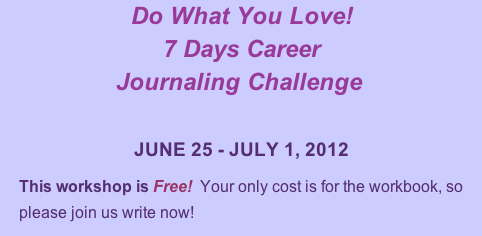
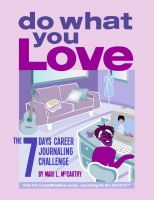
Thus I’m intrigued by a career-journaling challenge and workshop offered by Mari L. McCarthy, a well-known blogger on journaling. The workshop kicks off on Monday, June 25.

Though the workshop is free, the accompanying workbook, Do What You Love! The 7 Days Career Journaling Challenge, is $21.97, and you don’t get the details about the workshop until you buy the book.

Here’s what McCarthy’s site says about the eBook, Do What You Love! The 7 Day Career Journaling Challenge:
It “helps you discover your passions, and create the job where You can employ them! In this Journaling Therapy Workbook, You:

  • Explore how your past experiences — including your family environment, schooling and employment — have influenced your career path
  • Determine your core values and brainstorm how to put them into action in your work life
  • Identify your strengths, weaknesses, likes and dislikes to find a career that sparks your interest, passion and curiosity
  • Discover and embrace the career dreams you want to make a reality
  • Set concrete goals and establish a plan of action, while confronting your fears.”

Get details and sign up here.